


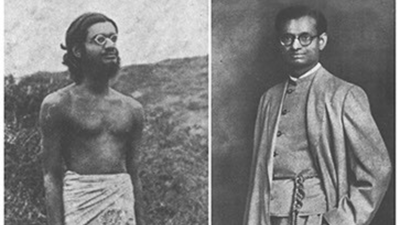
In the early decades of the 20th century, few lives followed a trajectory as unusual as that of Swami Jnanananda. Born in Andhra Pradesh, he spent years in spiritual practice across the Himalayas before turning to science, eventually studying physics in Europe, the United Kingdom, and the United States. His work focused on radiation and spectroscopy at a time when nuclear physics was rapidly emerging as a defining field of modern science. After returning to India, he helped build one of the country’s early academic centres for nuclear physics at Andhra University, combining scientific institution-building with a philosophical outlook shaped by years of meditation.
Swami Jnanananda ’s early life and spiritual journey
Born as Bhupathiraju Lakshminarasimha Raju, Jnanananda renounced conventional life at a young age and travelled through spiritual centres such as Rishikesh and the Himalayas. This period of meditation and ascetic discipline is often described as foundational to his later life.While detailed records are limited, accounts consistently suggest that this phase shaped his intellectual discipline, patience, and ability to engage deeply with complex problems. In many ways, the rigour of scientific research he later pursued mirrors the mental discipline cultivated during this spiritual period.
Turning to science in Europe
Jnanananda’s transition from spiritual seeker to scientist began in Dresden, Germany, where he studied mathematics and physics. He later moved to Charles University in Prague, focusing on X-ray physics and spectroscopy.At the time, X-ray spectroscopy was an important tool in understanding atomic structure, helping scientists analyse how radiation interacts with matter. His work in this area placed him within a broader global effort to understand atomic behaviour, which would later become central to nuclear physics. He earned an advanced research degree in the mid-1930s, marking his formal entry into the scientific community.
Research in the UK and the US
During the Second World War, Jnanananda worked at the University of Liverpool, one of the key centres of nuclear research in Britain. The university was closely associated with James Chadwick, whose discovery of the neutron had transformed the understanding of atomic structure and made nuclear reactions scientifically accessible.Jnanananda’s research focused on beta radiation spectroscopy, a field that studies the energy distribution of electrons emitted during radioactive decay. This work was important for understanding nuclear processes and the properties of unstable isotopes.He later continued his research at the University of Michigan in the United States, where access to advanced laboratory infrastructure allowed further work on radioactive materials and experimental techniques such as high vacuum systems. These systems are critical in physics experiments because they minimise interference from air particles, enabling precise measurements of radiation and particle behaviour.
Building nuclear physics in India
After returning to India in 1947, Jnanananda joined the National Physical Laboratory as a senior scientific officer, contributing to the country’s early post-independence scientific ecosystem.In 1954, he moved to Andhra University, where his most significant institutional work began. By 1956, he had established the Department of Nuclear Physics, creating infrastructure at a time when India was still developing its scientific base.He set up laboratories equipped for radiation studies, introduced experimental training programmes, and mentored students who would go on to contribute to India’s scientific landscape. The department’s research output and doctoral training helped position the university as an important centre for nuclear physics outside the direct control of the Department of Atomic Energy.
Contributions beyond the laboratory
Jnanananda’s work was not limited to experimental physics. He is credited with writing on high vacuum techniques, an essential component of many physics experiments involving particles and radiation.At the same time, he engaged deeply with philosophical thought, writing on Vedanta, yoga, and the relationship between science and spirituality. Rather than treating these as separate domains, he approached them as complementary ways of understanding reality, an approach that remains relatively rare even today.Swami Jnanananda’s life offers insight into a period when modern science in India was still being built by individuals who combined global training with local institution-building. His journey reflects three important ideas.First, scientific excellence in India often depended on individuals who trained abroad and returned to build institutions from scratch. Second, early nuclear physics research in India was not limited to government-led programmes but also grew within universities. Third, his life challenges the assumption that scientific inquiry and spiritual practice are inherently separate, showing that both can coexist within a single intellectual framework.His legacy continues through the institutions he helped shape and the broader idea that curiosity, discipline, and openness to different ways of thinking can lead to unexpected and lasting contributions.