


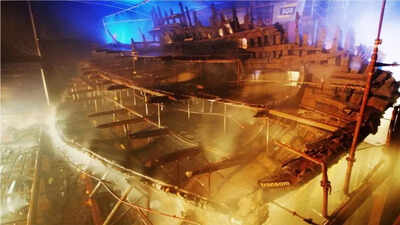
History is not just neatly stored in books lined up on the library shelf. It sometimes comes out of the cold darkness where one does not know where their body leaves off, and the world starts. Alexander McKee, historian to the British Army, collected a group of divers in 1971 and went underwater in the murky waters near Solent, Portsmouth harbour. But underneath all that was an agenda not easily noticeable on the 1841 maritime map.There was more to this battle than time. In the Solent, the tide is vicious, and it could be pitch black out there; so black, you couldn’t see your hand in front of your face. And through it all, McKee persevered. As they scanned the seabed, the divers discovered something unexpected. Three wooden ribs poked out from the silt. This piece of wood confirmed that this storied ship was not merely a legend. It was buried there, waiting to be found.The marine archaeologists were flabbergasted as if they had found a time capsule. It appears, according to studies conducted by researchers at Cambridge University, that the ship was well preserved due to its burial in mud. Thousands of objects have been found inside, providing insights into the daily lives of people, what they consumed and even the controversies of the 16th century. The bone remains found on board the ship indicate thriving trade relations between nations during the Tudor reign, including fish exported from Iceland.The great discoveryDiscovered in 1971, it gave rise to a completely different story. Over several years, diving experts managed to extract longbows, bronze cannons, and belongings of the crew. Nevertheless, one of the most difficult tasks was still ahead: how to extract the Tudor ship from the water without damaging it?In October 1982, the world watched in silence as a massive crane finally lifted the remains of the Mary Rose from her watery grave. It was a global event that bridged the gap between serious science and public spectacle. An estimated 60 million people tuned in to watch the live television broadcast as the hull broke the surface for the first time in 437 years. It was a rare moment where a piece of the 16th century literally rose back into the 20th century.
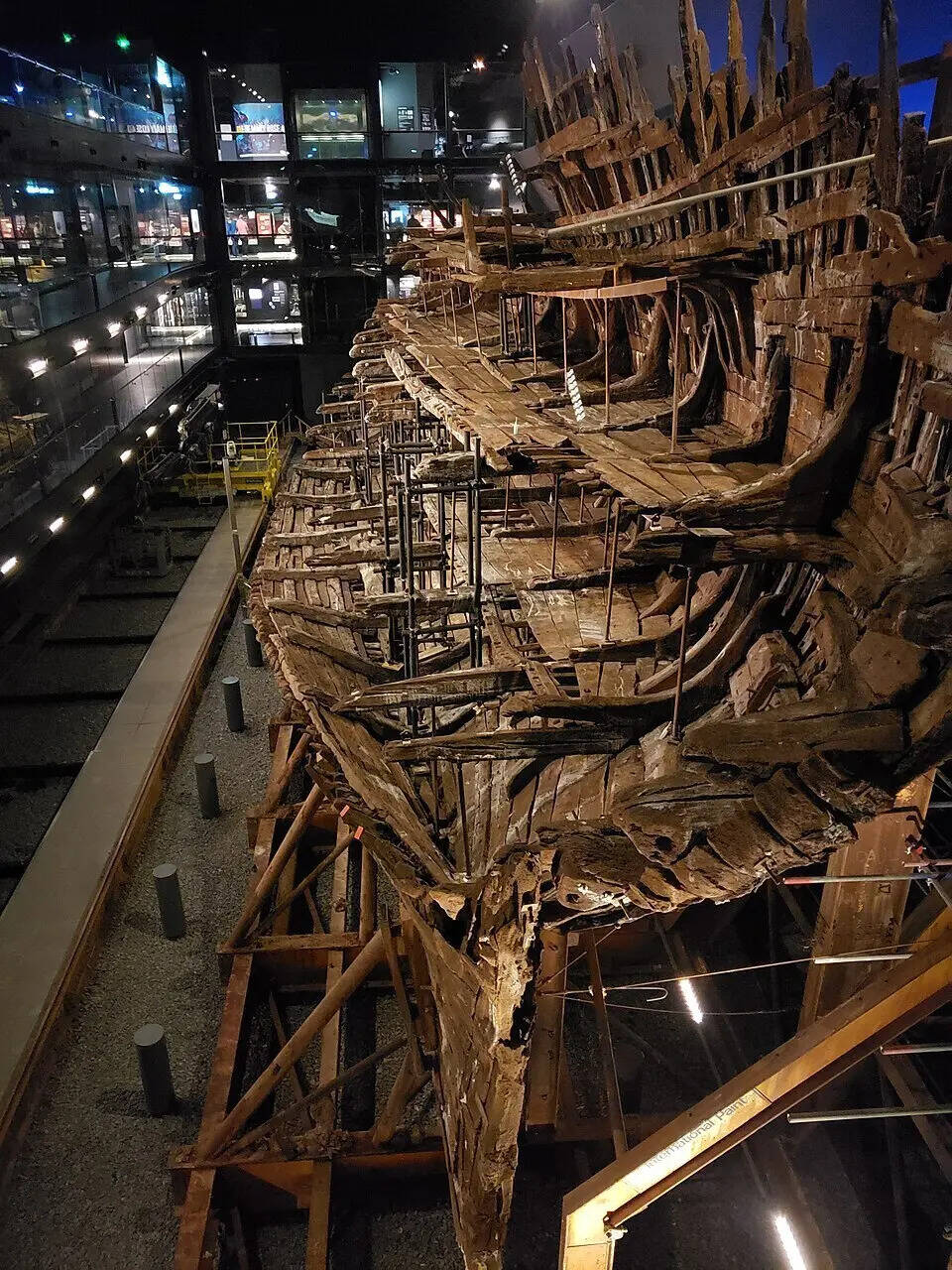
The ship’s dramatic 1982 recovery captivated the world, initiating ongoing conservation efforts to protect this significant piece of British history. Image Credit: Andy Li, via Wikimedia Commons
However, raising the Mary Rose proved to be the beginning of the lengthy conservation efforts that are still taking place today. According to Proceedings of the National Academy of Sciences, another threat occurred in the form of sulfur, which could cause acid production, leading to the destruction of timbers when the conservation is not constant. After the raising process, conservations went on, and the hull of the ship was covered by wax every once in a while.Preservation of history with wood and mudThe Mary Rose now rests in the Mary Rose Museum in Portsmouth, where the framework of the ship and the places where King Henry VIII used to walk around can be seen by people who visit this attraction. Unlike other wooden ships, what makes the Mary Rose unique is its exceptional state. This is due to the presence of Solent mud.The hunt by Alexander McKee in 1971 proved that ordinary people using dusty maps and normal excitement could come up with some of the best discoveries on earth. The search was not just about the treasure of gold or cannons, but the rediscovery of part of humanity’s history. These three ribs, which the scuba divers recovered from beneath the silt, grew into some of the greatest excavations ever carried out in Britain.This is proof that history can be lying just under our feet, awaiting someone who has a map and enough curiosity to uncover it. The Mary Rose did not simply go down in 1545; she had been lying around for almost five centuries before finally having her story told thanks to a guess made by a historian.
