


BENGALURU: Bengaluru retained its No. 1 position as the top city for women in India, reaffirming its leadership in creating a balanced ecosystem across social and industrial dimensions. Chennai, Pune, Hyderabad and Mumbai completed the top 5, workplace consulting firm Avtar’s Top Cities for Women in India (TCWI) 2025 report showed. Gurugram stood out among the top 10, climbing to No. 6 from No. 9 last year, driven largely by gains in industrial inclusion. The 2025 edition of TCWI covered 125 cities and drew comparisons with previous editions since the year 2022. The report tracked women’s inclusion across Indian cities through a longitudinal index covering participation, safety and career continuity. Cities were ranked based on the City Inclusion Score (CIS), derived from two parameters: Social Inclusion Score (SIS) and Industrial Inclusion Score (IIS). The SIS measured a city’s liveability, safety, women’s representation in employment, and broader indicators of women’s empowerment. The IIS evaluated the extent to which organisations across industries were inclusive of women, reflecting workplace participation and representation, the presence of women-friendly industries, and career enablers provided by employers.
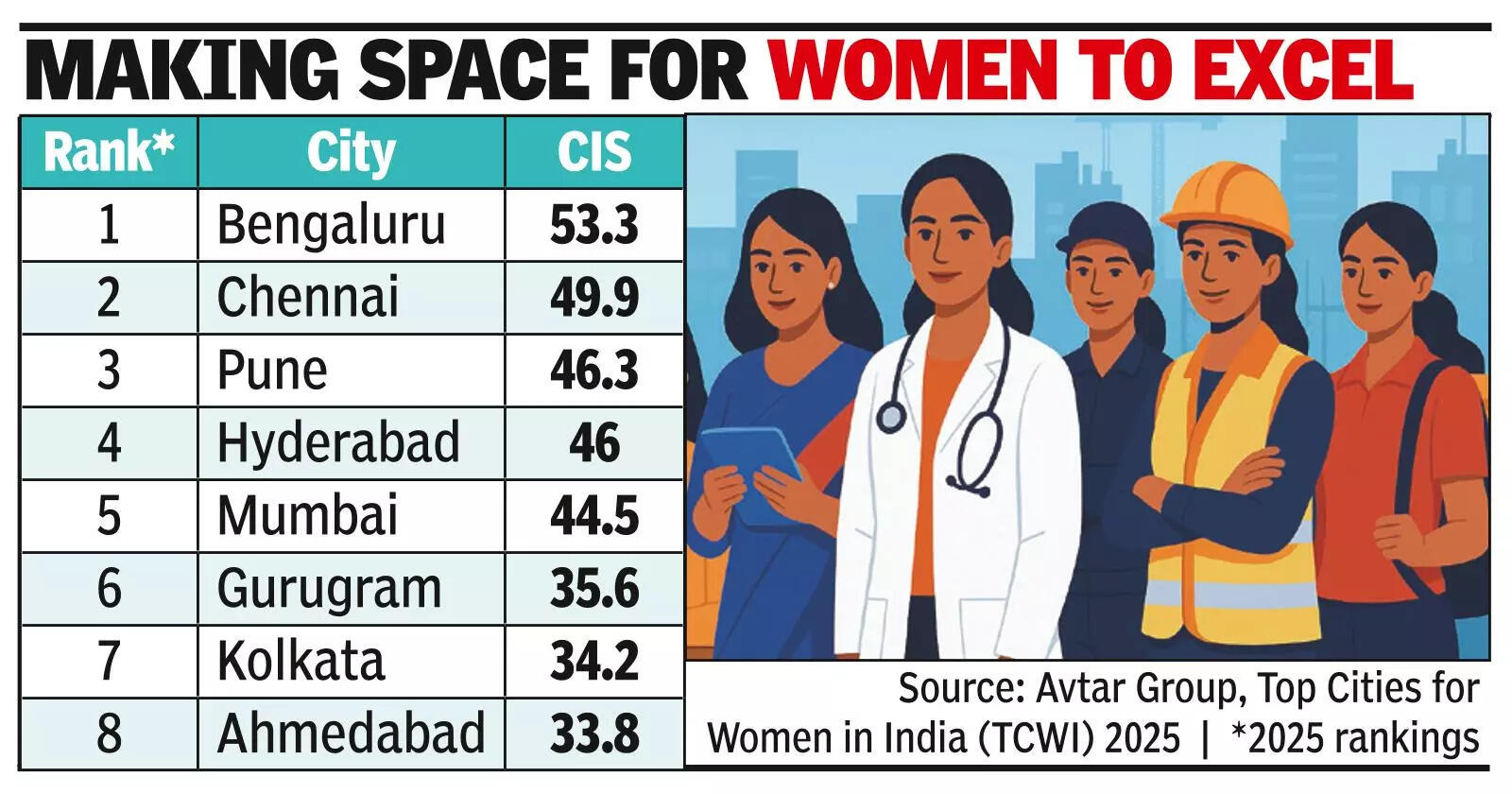
Bengaluru led with a CIS of 53.2, driven by sustained strength in industrial inclusion and career enablement. Chennai ranked second with a CIS of 49.8, continuing to excel in social inclusion, particularly in safety, public services, mobility, and access to health and education. Pune (46.2), Hyderabad (46), and Mumbai (44.4) completed the top 5, showing consistent performance across both social and industrial parameters. The report said that Bengaluru’s ease of living for women is driven by an employment-first design supported by strong safety and skilling infrastructure. Women help desks, tech-enabled and community policing reduced response times, lowering risks linked to commuting and late working hours, while NGO-led street-lighting audits improved public space safety.Key Findings of the Top Cities for Women in India 2025 report:– Bengaluru retains its position as the top city for women in India in 2025, with a City Inclusion Score of 53.29, reflecting sustained strength in Industrial Inclusion and career enablement.– Chennai follows in second position with a City Inclusion Score of 49.86, while continuing to lead on social inclusion parameters such as safety mechanisms, public services, mobility initiatives and access to health and education.– Pune (46.27), Hyderabad (46.04), and Mumbai (44.49) complete the top five, demonstrating consistent performance across both social and industrial inclusion indicators.– Gurugram records one of the most notable upward movements, strengthening its position in 2025 compared to 2024, supported by rapid industrial growth and strong corporate presence (Rank no. 6 in 2025 compared to No. 9 in 2024).– Delhi, Gurugram, and Noida perform strongly on industrial inclusion but lag on social indicators such as safety, affordability, and mobility, reinforcing that industrial growth alone does not ensure inclusive urban environments.– Thiruvananthapuram, Shimla and Tiruchirappalli demonstrate strong social inclusion outcomes but limited industrial depth, pointing to constraints in local economic mobility for women and limitations in large-scale formal employment opportunities for women despite strong social foundations.– Hyderabad, Kolkata and Pune stand out for fairly balanced inclusion profiles, with strong alignment between social inclusion and industrial ecosystems, enabling sustained workforce participation for women.– Mumbai shows strong industrial inclusion (with an IIS of 69.00) but relatively weaker social inclusion (with a SIS of 38.44), highlighting challenges around affordability and access to infrastructure despite abundant employment opportunities.– The 2025 TCWI rankings show increased representation of Tier-2 cities among higher ranks, indicating decentralisation of women-friendly urban ecosystems.Regional analysis– The Southern region emerges as the most inclusive, recording the highest scores across all three indices, with a regional average CIS of 21.60, SIS of 27.81, and an IIS of 11.61, reflecting a more integrated approach to social infrastructure, safety, health, education, and industrial participation for women.– The Western region follows closely, demonstrating consistently strong performance with a regional average CIS of 20.00, SIS of 25.47, and the highest IIS among regions at 12.01, indicating relatively mature industrial ecosystems supported by enabling social conditions.– Central and Eastern regions trail across both inclusion dimensions – social and industrial – especially industrial inclusion, with regional average IIS scores of 4.96 and 4.40, respectively.Across 2022-2025, cities achieving convergence between Industrial Inclusion (IIS) and Social Inclusion (SIS) consistently rank higher on overall City Inclusion (CIS), reinforcing that industrial growth is most effective when supported by safe, accessible, and equitable urban environments.