


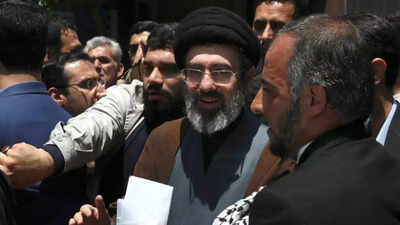
Mojtaba Khamenei, Iran’s newly appointed supreme leader and the son of the late Ayatollah Ali Khamenei, has long operated behind the scenes in the Islamic Republic’s power structure. Despite maintaining a low public profile for decades, the 56-year-old cleric is believed to have built a sprawling international investment network, with assets ranging from luxury properties in London to hotels in Europe and businesses in the Persian Gulf. Reports and investigations by Western media and officials suggest that the assets, often held through intermediaries and shell companies, could be worth hundreds of millions of dollars.
From London’s luxury homes to Dubai villas and European hotels
Investigations into Mojtaba Khamenei’s financial dealings suggest that the cleric has overseen a vast web of investments across Europe and the Middle East.According to reports, properties linked to the network include luxury homes in some of London’s most exclusive neighbourhoods, particularly on The Bishops Avenue, often dubbed “Billionaire’s Row”. One mansion alone reportedly cost £33.7 million when it was purchased in 2014. In total, real estate holdings linked to the network in the UK are believed to be worth more than £100 million (about $138 million).Beyond Britain, assets tied to the network reportedly include a luxury villa in Dubai, sometimes described as the “Beverly Hills of Dubai”, and high-end hotels in cities such as Frankfurt in Germany and Mallorca in Spain. Property records also point to past holdings in Paris and a penthouse in Toronto’s Four Seasons Private Residences, which was sold in 2020.Financial transfers for these purchases were allegedly routed through bank accounts in the United Kingdom, Switzerland, Liechtenstein and the United Arab Emirates.Much of the wealth used for these investments is believed to have originated from Iran’s oil trade, with funds moving through a complex network of companies and intermediaries.
The role of business allies
One of the key figures believed to be central to this financial network is Iranian businessman Ali Ansari, a construction magnate and banking executive who has been sanctioned by the United Kingdom.Investigators and analysts have suggested that companies linked to Ansari, including offshore firms and hospitality businesses in Europe, were used to channel investments abroad.Many of the properties and companies linked to the network are not directly registered in Mojtaba Khamenei’s name, but instead appear under intermediaries or corporate entities. Ansari has denied any financial or personal relationship with Khamenei and has said he intends to challenge the sanctions imposed on him.Analysts say such arrangements are common among elites in heavily sanctioned countries, allowing wealth to move through global financial systems despite restrictions.
Moving money despite sanctions
The alleged overseas empire highlights how Iran’s elite have managed to move capital abroad despite decades of sanctions imposed over Tehran’s nuclear programme and regional policies.Experts say the use of shell companies, offshore financial centres and intermediaries allows sanctioned individuals to access Western financial systems.Some officials and anti-corruption campaigners in Europe have raised concerns about how international property markets, particularly in cities such as London, have been used to store wealth linked to political elites from sanctioned regimes.
What we know about Mojtaba Khamenei
Mojtaba Khamenei, born on September 8, 1969, in Mashhad, is the second son of Iran’s long-time supreme leader Ayatollah Ali Khamenei.Despite decades of influence within Iran’s ruling establishment, he has largely remained out of the public spotlight. He has never held elected office and rarely appears in public speeches or media interviews.As a teenager, he briefly served during the Iran-Iraq War in the 1980s. He later pursued religious studies in the Shiite holy city of Qom, eventually becoming a mid-ranking cleric.Over the years, Mojtaba developed strong ties with Iran’s powerful Islamic Revolutionary Guard Corps (IRGC), which is widely believed to have played an important role in consolidating his influence within the regime.His name first gained wider attention during Iran’s 2005 presidential election, when reformist politicians accused him of using his connections with the IRGC and the Basij militia to support the candidacy of hardline president Mahmoud Ahmadinejad. Similar allegations resurfaced during the disputed 2009 election that triggered mass protests known as the Green Movement.US diplomatic cables later described him as “the power behind the robes”, suggesting he played a crucial role in managing access to his father and shaping internal political decisions.
A controversial succession
Following the death of Ayatollah Ali Khamenei, Mojtaba was selected by Iran’s Assembly of Experts to become the country’s new supreme leader, only the third since the Islamic Republic was founded in 1979.The decision has sparked debate because Iran’s political system was originally designed to avoid hereditary leadership, with the supreme leader theoretically chosen based on religious authority and leadership credentials rather than family ties.Critics argue that his elevation effectively creates a dynastic succession within the Islamic Republic, something many Iranians have historically opposed.
Challenges ahead
Mojtaba Khamenei assumes leadership at a particularly turbulent moment for Iran. The country faces deep economic hardship, growing public dissatisfaction, and mounting geopolitical tensions. In recent years, protests sparked by economic pressures and political repression have posed one of the biggest challenges to the Islamic Republic in decades.Against this backdrop, scrutiny over the wealth and foreign investments linked to the new supreme leader and his associates could further fuel criticism among Iranians already frustrated by corruption and economic inequality.While Mojtaba Khamenei has wielded significant influence behind the scenes for years, his leadership record remains largely untested, and his ability to navigate Iran through its current political and economic crises will now be closely watched.