


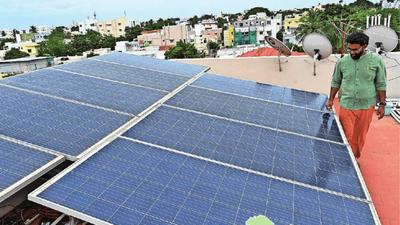
Two years since a national scheme for solar power systems was rolled out, more than 25 lakh sets have been installed across the country, and at least 12.5 lakh beneficiaries have seen one month’s electricity bill go down to zeroWhen Vinod Agarwal, a resident of Uttar Pradesh’s Sahibabad, began noticing rooftop solar panels glinting under the afternoon sun across his neighbourhood, he was curious. But the curiosity soon turned into eager calculation, when a neighbour told him that his electricity bill had dropped to almost nothing, even as another neighbour showed him a mobile app that tracked daily power generation.Agarwal did the math. His monthly consumption hovered around 250-300 units. With tariffs inching up each year, the savings looked compelling. Within weeks, he applied under the PM Surya Ghar: Muft Bijli Yojana, and installed a 3kW system. Today, in months when his consumption stays within the generation limit, his electricity bill reads zero.“I had seen it working in homes around me. That gave me confidence,” Agarwal said. “The dual subsidy from the Centre and the state govt made the decision easier.”Powering The NumbersAgarwal’s story mirrors a wider shift playing out across the country. Launched on Feb 13, 2024, the PM Surya Ghar scheme seeks to install rooftop solar systems (RTS) in one crore households by March 2027, with a financial outlay of Rs 75,021 crore. The Centre offers a one-time subsidy of up to Rs 78,000 per household, while several states provide additional support.Two years into the rollout, the numbers indicate steady momentum. According to the national portal, 25,28,993 rooftop systems, with an aggregate capacity of about 9,249MW, had been installed till date. The Centre has already distributed subsidies worth Rs 17,886 crore. And more than 12.5 lakh consumers have received electricity bills that read “zero” in at least one month since the launch.A standard 3kW rooftop plant can generate roughly 300 units of electricity a month — sufficient for many middle-class households to offset their entire consumption. When rooftop solar systems installed before the launch of the PM Surya Ghar: Muft Bijli Yojana are included, the number is estimated to be nearly 32 lakh.Uneven GrowthGujarat leads with nearly 5.8 lakh installations, followed by Maharashtra (4.8 lakh), Uttar Pradesh (4 lakh) and Kerala (more than 2 lakh). In contrast, adoption remains muted in the North-East. Arunachal Pradesh, Sikkim, Meghalaya, Mizoram, Manipur, Nagaland and Tripura together account for only about 4,500 installations, largely because of lower solar potential due to climate and terrain, apart from lower household load, grid connectivity challenges and lower disposable income. Delhi, Goa, West Bengal and Chandigarh have also posted modest numbers.Officials acknowledge that nearly three-fourths of the installations are concentrated in 10-11 states. One reason is policy-readiness. Several states are yet to notify virtual net-metering guidelines, which allow households to feed surplus electricity into the grid and receive credits or payments.“This is a model with a customer-first approach and has become immensely popular. People see rooftop solar at their neighbours’ homes and get inspired. We want adoption across all states and are holding regular meetings with state govts,” said JVN Subramanyam, joint secretary, ministry of new and renewable energy.Also, states that offer free electricity or subsidies to frugal consumers — Punjab, Delhi, Karnataka, Jharkhand and Tamil Nadu — have seen poor penetration of rooftop solar systems.Subramanyam, however, said the deployment has seen rapid acceleration in the last few months. Monthly installations have climbed from around 15,000 at the time of launch of the scheme to over 2 lakh now. He said more than 90% of the funds allocated in the 2025-26 Union Budget were utilised within 10 months of the financial year, reflecting strong demand. The ministry of new and renewable energy has allocated Rs 22,000 crore for subsidy under the scheme in the 2026-27 Budget.Ecosystem ChallengeIndustry players, however, caution that the headline numbers mask persistent bottlenecks. Financing remains one of the weakest links. Even after subsidies, installing a rooftop solar system typically requires an upfront investment of Rs 2-2.5 lakh. Over 75% of consumers seek loans to bridge the gap. While nationalised banks and non-banking financial institutions do provide easy loans to consumers, documentation, in many cases, takes a lot of time, making the process cumbersome. “The process is slow, requires branch visits, and approvals can take two to five weeks,” said Shreya Mishra, co-founder and chief executive officer of SolarSquare, a leading player in the rooftop solar business.Bhawna Tyagi, programme lead, Council on Energy, Environment and Water (CEEW), said India has a realistic residential rooftop solar potential of 118GW at current consumption levels — far above the capacity installed so far.“To bridge the gap and tap into this immense potential, targeted consumer sensitisation on the adoption steps is needed,” she said. “Equally important is building the capacity of financing institutions at district and block levels so that access to affordable credit improves, and local bank officials are aligned with central guidelines.”Baldesh Singh, renewables market analyst at S&P Global Energy, also noted that upfront costs continue to pose a barrier despite subsidies. “Customer experience with banks has been uneven and it varies by state. Loan rejection and delays in processing applications are among the key barriers,” he said.Subramanyam said the govt was working with banks to simplify financing. He added that the application process was now fully online and included geotagged terrace photos to avoid physical inspections.Subrahmanyam Pulipaka, chief executive officer at the National Solar Energy Federation of India, said awareness remained a key challenge for both the govt and consumers. “While there is broad awareness about the scheme, understanding of the application process, system details and technical aspects is still limited,” he said, adding that many organisations and civil society groups were working on the ground to spread awareness.Trust And Quality AssuranceA rooftop solar installation is a complex system and contains multiple components — solar photovoltaic modules or panels that convert sunlight into DC electricity; inverters to convert DC to AC; mounting structures to secure panels; cables and wiring; a lightning arrestor and earthing kit, and many more. The system requires regular cleaning and maintenance to ensure optimum performance. However, dust, bird droppings, and shadow often lead to a fall in performance, and the generation may decline by 20-30%, or even more.Experts said quality control lapses have been reported in some cases, reflecting gaps in technical expertise and adherence to safety standards. Poorly mounted panels, improper wiring, or inadequate earthing not only reduce generation but also pose safety risks.Saurabh Marda, co-founder of Freyr Energy, one of India’s largest rooftop solar companies, said the biggest mistake customers make is choosing the wrong vendor. “Poor customer experience begins from selecting the wrong solar company. Customers get swayed by lower upfront prices without checking the installer’s track record, and that’s where problems start,” he said.Prospective buyers, he said, should review installation data available on the PM Surya Ghar portal to assess a company’s experience. According to him, inexperienced local players sometimes quote non-inclusive prices with hidden costs, install substandard systems, and may exit the business within a few years — undermining consumer confidence and the subsidy framework.Tyagi said a poorly maintained system not only suffers from low energy output, but it may also lead to extended payback periods and reduced lifespan. Citing a CEEW 2023 study, she said soiling, shadow effects, shattered modules and wiring issues can cause capacity utilisation factors to vary widely.“There is need for a standard operating procedure for consumers after the annual maintenance contract ends,” Tyagi said. Building consumer capacity to periodically clean panels, monitor performance and report faults will ensure systems deliver on promised benefits.While some companies sell technologically advanced systems that inform customers, via apps, that the installation requires cleaning, and some have a self-cleaning system, Mishra said a new ecosystem is slowly developing where companies offer cleaning of the system at a price.Grid Stability A ConcernAs rooftop penetration deepens, grid-readiness is another dimension that requires attention. A senior discom official said that, during sunny, high-generation hours, rooftop solar installations often produce more electricity than households consume, resulting in a significant surplus of energy fed back into the utility grid. Insufficient energy during non-solar hours causes a sharp, sudden demand for conventional power from the grid, leading to voltage fluctuations, instability, and overloading.Ensuring that distribution networks can accommodate large-scale RTS penetration will be critical. Experts suggest that additional support for hybrid systems integrating battery storage could ease grid stress and enhance reliability, particularly during peak hours. Officials, however, accept that a hybrid system with a battery means an additional cost of nearly Rs 50,000. Marda said most cities don’t see prolonged power cuts; hence, installing battery storage is not recommended, as it involves an extra cost.From a market perspective, analysts point out that sustained momentum will depend on maintaining process efficiency and administrative coordination across states and distribution companies. Achieving the one-crore target hinges on smoother net-metering approvals, faster subsidy disbursal and improved consumer trust.Back in Sahibabad, Agarwal says his decision has sparked interest among relatives in other cities. “They ask about costs, savings, maintenance. I tell them to choose a good company and keep documents ready.”