


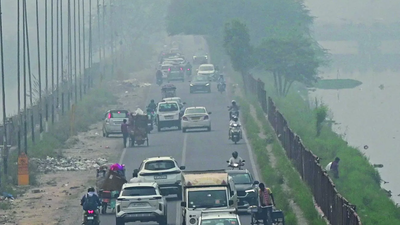
NEW DELHI: Unseasonal fog and haze that appeared in parts of north India, including Delhi-NCR, Tuesday morning is unlikely to have been caused by smoke and soot rising from oil depots and facilities in war-hit Iran that have been burning for three days, experts said. While upper atmospheric winds from Iran are moving west, the plume from the fires hasn’t travelled far enough, said air pollution expert Gufran Beig from National Institute of Advanced Studies, Bengaluru. “Satellite images show the plume has travelled close to 500km, around a fourth of the distance to India. It’s unlikely to survive long enough to impact air quality here, unless the fires persist with high intensity and mix with dust storms,” Beig said.Fog/haze was seen over north India, from Haryana to Bengal and beyond on Tuesday, with lowest visibility in NCR recorded at 600m at Hindon Airport at 7-8am.Reports said the bombing of Iran’s oil infrastructure left massive fires that are likely to have major long-term environmental repercussions. Black rain fell across Tehran hours after the strikes and the sun remained blotted out. There was speculation that the toxic smoke could spread across the region and may even reach India. “The wind direction is likely to be favourable for transport of soot from Iran towards India. But whether it will actually travel that far depends on many factors such as the type of smoke, its depth in the atmosphere and its capacity to persist in the air. These are outside the IMD’s purview,” said IMD chief Mrutyunjay Mohapatra. Met officials said the haze in north India was formed because of moisture-laden easterly winds coming into the region where conditions were calm at lower levels. While haze/ fog in warm March conditions is rare, it isn’t unheard of. “Data shows that during early March, dense fog has occurred in the region. On March 6-8, 2008, fog triggered failure of power transmission lines across north India,” said R K Jenamani, senior scientist at IMD. As per Mahesh Palawat from Skymet, the haze was likely due to a combination of dust and moisture under the influence of an ongoing western disturbance. He said another western disturbance may impact the region, thus marginally dropping the daytime temperatures from March 14 onwards, with chances of rain on March 15. “This is haze, caused by dust carried from Balochistan and the Thar Desert of Rajasthan,” Palawat said. Meanwhile, Delhi on Tuesday recorded the fourth straight day of maximum temperatures above 35 degrees Celsius. The maximum was 35.5 degrees C, 7 notches above normal, against 35.3 degrees C a day earlier. The minimum temperature was recorded at 18.8 degrees C, 5 notches above normal, against 19 degrees Celsius a day earlier. IMD expects the maximum and minimum to hover around 35-37 degrees and 17-19 degrees C on Wednesday, and gradually reduce by March 15. Meanwhile, the air quality worsened within the poor level. The AQI, on a scale of 0 to 500, was 265, against 209 a day earlier. “Air quality is likely to be in the poor category from March 10 to 11. It’s likely to be in moderate category on March 12 and 13,” a statement from the Centre’s early warning system said.