


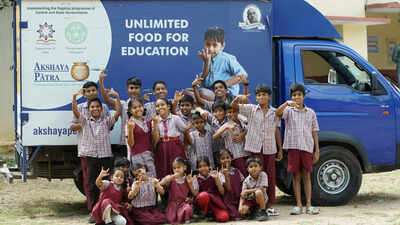
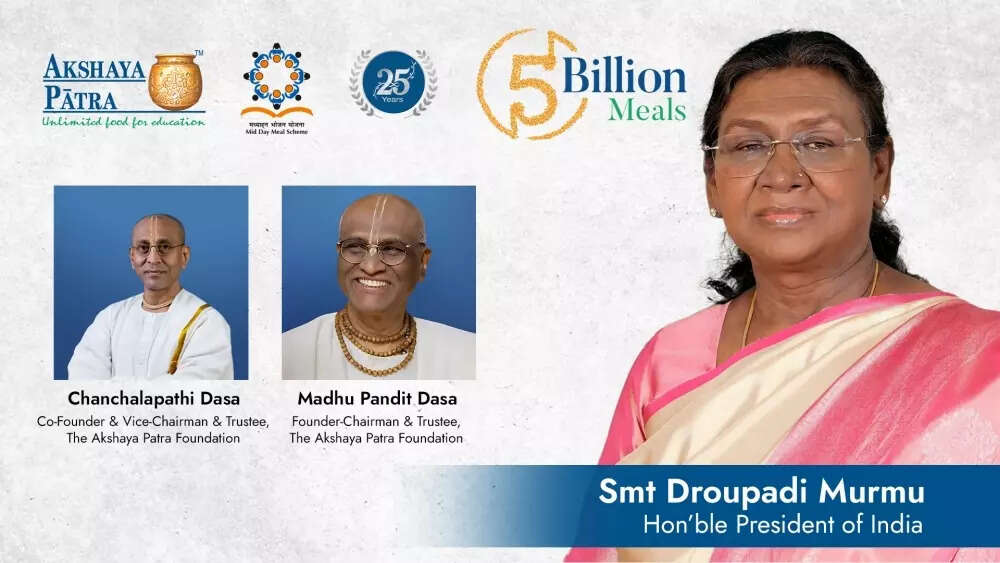
As The Akshaya Patra Foundation prepares to serve its 5 billionth meal on March 17, with President Droupadi Murmu commemorating the milestone, the moment marks a significant chapter in one of the world’s largest school feeding programmes. What began in 2000 with just 1,500 meals served from the ISKCON temple in Bengaluru has grown into a nationwide initiative that now feeds over 2.35 million children every day. In this conversation, Sri Madhu Pandit Dasa, Founder–Chairman of The Akshaya Patra Foundation, discusses the organisation’s 25-year journey and its work in supporting school nutrition programmes across India. He reflects on partnerships with governments under the PM POSHAN programme, the role of technology in scaling large-scale meal operations, and initiatives such as the Morning Nutrition Programme that seek to strengthen the connection between nutrition, education, and long-term child development.1. With Droupadi Murmu set to serve The Akshaya Patra Foundation’s 5th billion meal on March 17, how significant is this milestone for the organisation and the scale of impact it has achieved so far?The 5 billion meals milestone is a profound moment not just for Akshaya Patra, but for India. When we began in 2000, cooking 1,500 meals at ISKCON Bangalore Temple, we could not have imagined where we would be 25 years later. As we complete 25 years in the service of children, each of the 5 billion meals we have served represents our commitment to a world where no child has to choose between food and education; instead, they have the best of both.It is an honour for us to have the President of India, Droupadi Murmu ji, commemorating this landmark milestone as our chief guest. Her presence is a powerful affirmation that ensuring the nutrition and well-being of India’s children is a national priority. The 5 billion meals milestone is a testament to what becomes possible when compassion meets commitment.We are also thankful to Minister of Education, Dharmendra Pradhan, for consenting to be our Guest of Honour for this event.2. The foundation recently introduced the Morning Nutrition Plan. What gap does this initiative aim to address, and how widely has it been implemented so far?The Morning Nutrition Programme aligns with our commitment to ensuring that no child is deprived of education because of hunger. We have observed that many children come to school hungry. By implementing the programme, we strive to address this morning nutrition gap.A child who starts the school day nourished is one who can truly make the most of the educational opportunity. The Morning Nutrition Plan is our commitment to making that a reality. We are currently implementing the Morning Nutrition Programme in six states, reaching 8 lakh children, and are working to scale the initiative across more locations.3. With millions of meals prepared daily, what processes are in place to ensure food safety, nutritional balance, and quality control at every stage?At Akshaya Patra, we combine scale with systems that ensure high standards of hygiene, consistency and efficiency. A key element is automation, with equipment such as rice washers, dal cooking systems, vegetable cutters and chapati-making machines that minimise manual handling and enable large quantities of food to be prepared with uniform quality.We operate under strict standard operating procedures (SOPs) that govern procurement, storage, preparation and packaging. Raw materials are quality-checked on arrival and food safety protocols are followed throughout the cooking process. Regular internal audits and monitoring help maintain compliance with hygiene and nutrition standards.Technology-enabled monitoring systems help track production, ingredient utilisation and daily meal requirements, ensuring operational efficiency and reducing wastage. In addition, scientifically designed menus ensure meals meet nutritional guidelines while reflecting local tastes.Finally, a streamlined logistics system, supported by specially designed food delivery vehicles, ensures that freshly prepared meals reach schools on time while maintaining quality and safety.4. The organisation works closely with multiple state governments under the Mid-Day Meal programme. How do these partnerships shape your operations on the ground?Our partnership with the Government of India and State Governments is the very foundation of what we do. Under the visionary leadership of our Prime Minister, Narendra Modi, the PM POSHAN programme continues to strengthen the link between nutrition and education.As an implementing partner of PM POSHAN, the partnership gives us the reach, the mandate and a significant portion of the funding required to operate. The Government provides the policy framework, maps schools to us, and supports meal cost contributions. We bring the operational model, technology, trained workforce and the additional funding we raise from corporate partners and individual donors. So the Government provides support on policy, grants and other important areas, while Akshaya Patra focuses on large-scale meal preparation, logistics and quality assurance. The shared commitment is what allows us to plan, invest and operate with confidence on the ground.
5. As conversations around nutrition and education become more interconnected, how does Akshaya Patra see its role in supporting children’s overall development beyond addressing hunger?A hungry child cannot concentrate, cannot absorb and definitely cannot aspire. A healthy child is more likely to attend school regularly and focus better on learning. When we provide a meal, we are not just addressing hunger. We are creating the conditions for learning and growth… for a child to imagine a future.And for the girl child, the impact is intergenerational. A nourished, educated girl raises a nourished, educated family. In that sense, our work is not just about food. It is about human potential.We have also designed and implemented initiatives that go beyond meals to support the overall development of children. These include the Giving Every Dream a Chance initiative, which mentors children in pursuing their areas of interest, and the Scholarship Programme, which provides financial assistance to students for higher education.6. Over the past 25 years, the organisation has expanded significantly. What were some of the key milestones or shifts that helped accelerate this growth?Several milestones stand out in our 25-year journey.The first was in 2003, when the Government of India made the landmark decision to invite NGOs as implementing partners in the Mid-Day Meal (MDM) Scheme. It laid the foundation for us to operate at a scale we could not have achieved independently.Our partnership with State Governments enabled the programme to expand across geographies and reach children in diverse regions of the country. These partnerships have been central to adapting our operations to local needs while maintaining consistency in the quality and delivery of meals.Another important driver of growth has been leveraging technology and operational innovation. The development of large-scale, technology-enabled kitchens and robust supply chain systems has allowed us to serve nutritious meals efficiently, safely and at scale, helping us reach more children each year.The support of corporate partners and individual donors has also played a vital role in our journey. Their contributions have enabled the creation of kitchen infrastructure, operational expansion and programme innovation, strengthening the public–private partnership model that underpins our work.Akshaya Patra’s work was recognised through awards such as the Gandhi Peace Prize, National Award for Child Welfare, Nikkei Asia Prize, and BBC Global Food Champion Award, among others1. Our systems and processes have become case studies at leading universities such as Harvard University, Stanford University, and London Business School. We celebrated our 4 billion meals milestone at the UN Headquarters in New York in 20242. We are fortunate to have the President with us for the 5 billion meals milestone and the completion of 25 years on March 17. Encouragement from such distinguished leaders, along with national and international awards and recognitions, has significantly strengthened the organisation’s credibility.Such instances have raised visibility for the school feeding cause, reinforced stakeholder confidence and enabled us to strengthen partnerships and reach more children over time.7. Technology and innovation have become central to improving large-scale social initiatives. How has Akshaya Patra integrated these elements into its kitchens and supply chain systems?Technology and innovation play a key role in enabling us to deliver meals at scale with efficiency and consistency. Every day, our kitchens prepare meals for 2.35 million children with precision and consistency, ensuring nutritional standards are met in every meal. Our semi-automated kitchens use large rice and dal cauldrons and high-capacity roti-making machines, enabling us to prepare large volumes of meals efficiently while maintaining hygiene and consistency. In logistics, we use route optimisation and fleet management tools to ensure timely delivery across thousands of schools.Our aim is to serve every child with the same quality and care every single day. Technology and innovation help us make this possible.8. Looking ahead, what are the foundation’s priorities for the next phase of growth, both in India and potentially on the global stage?We strive to reach more children and strengthen nutrition delivery. To this end, we intend to design and implement initiatives that complement the Mid-Day Meal Programme. The Morning Nutrition Programme, for instance, ensures that children begin the school day nourished and ready to learn. Similarly, the School Rejuvenation Programme creates safe and hygienic spaces where children can receive their meals. We will continue strengthening partnerships with governments, institutions and philanthropic supporters to sustain and expand the programme’s reach.We aim to support broader efforts to address classroom hunger and improve access to education worldwide through knowledge sharing and collaborative partnerships. In 2024, we collaborated with a Kenya-based not-for-profit, Food4Education, as a knowledge partner to share insights on kitchen operations and scaling strategies3. We will continue to build such partnerships and share our operational learnings and scalable models with other nations to explore large-scale school feeding initiatives.Inspired by the success of Akshaya Patra, the World Food Movement was launched last year to take the idea of large-scale nutrition programmes beyond India. The initiative aims to support students and communities globally so that children can learn with energy and communities can thrive with dignity.References: Disclaimer – The above content is non-editorial, and TIL hereby disclaims any and all warranties, expressed or implied, relating to it, and does not guarantee, vouch for or necessarily endorse any of the content.