


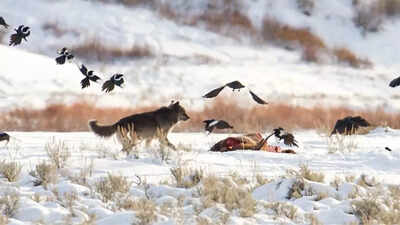
For a long time, scientists thought ravens simply trailed wolves to feed on fresh carcasses. The idea was straightforward. Follow the predator and grab the meal while the blood is still wet. Recent research, though, paints a different picture. Conducted over two and a half years in Yellowstone National Park, the study suggests that ravens rely on their spatial memory to locate wolf kills. They do not need to stalk wolves closely. Instead, they seem to know the landscape and return to spots where kills are likely to occur. The research was published in Science and led by the Research Institute of Wildlife Ecology at the University of Veterinary Medicine Vienna, together with the Max Planck Institute of Animal Behaviour in Germany.
How ravens use memory to find wolf kills instead of following them
Researchers tagged 69 ravens with small GPS devices, as reported by The CSR Journal. This allowed them to monitor the birds’ movements in detail. They also tracked 20 wolves during the winter months. Ravens were logged every 30 minutes, and wolves every hour. Surprisingly, there was only one instance where a raven followed a wolf for longer than a kilometre or more than an hour.The study titled, ‘Ravens anticipate wolf kill sites across broad scales’, published in Science, shows that ravens are not shadowing wolves as closely as previously thought. Instead, they appear to use memory and intuition. Some birds reportedly flew up to 155 kilometres in a single day toward likely carcass sites.
How Ravens remember the land
The Science study shows that ravens have a remarkable ability to remember stable food sources. They seem to learn which areas are historically prone to wolf kills. Flat valley bottoms where wolves hunt successfully are some of the most productive areas. A single kill is unpredictable, but certain areas regularly provide food over time. Ravens reportedly exploit these patterns, increasing their chances of finding a meal without relying on wolves to lead the way.Experts say this extends what we know about scavenger behaviour. They are planners in their own right.
How ravens’ memory are changing what we know about scavengers
This research could reshape how we understand scavengers. Ravens do not appear tied to a single wolf pack. They are flexible, choosing foraging spots based on memory and environmental cues. They can scan vast areas and then return to locations that previously yielded results.Senior author John M. Marzluff of the University of Washington suggests that some scavenger species might have been underestimated in their cognitive abilities. Ravens, it seems, combine instinct with memory to maximise survival.