


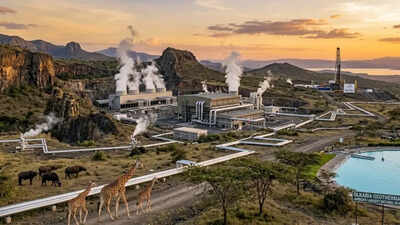
Located in the scenic cliffs of the Great Rift Valley, Naivasha has gone from being a beautiful lakeside destination to one of Africa’s leaders in terms of renewable energy production. By taking advantage of the geothermal power produced by the volcanic forces found under Hell’s Gate National Park, Naivasha now serves as the primary anchor of Kenya’s energy security, generating close to half of the country’s total electricity. This new source of energy – derived from the Earth – is a reliable, continuous, clean energy source, allowing for the continued development of industries and the protection and conservation of the environment. Today, Naivasha is a model for other countries to follow, since it can produce power for industrial activities without adversely affecting the surrounding wildlife and supporting one of the country’s leading floriculture industries while protecting the national electricity grid from the effects of climate change.
How Naivasha became the geothermal capital of Kenya
Naivasha’s rise to its current status of being the Geothermal Capital of the world started with the completion of the Olkaria I power plant in 1981; therefore, Kenya is the first African country to harness geothermal steam from volcanic sources. According to the study published on the International Renewable Energy Agency (IRENA), being located on a major tectonic plate boundary gives Naivasha an advantage with regard to its thin continental crust and high thermal gradient; as a result, magma in the region heats subterranean aquifers to temperatures above 300 degrees Celsius. Consequently, this unique location provides Naivasha with the ability to produce about 900 megawatts (MW) of energy from the Olkaria geothermal complex, representing approximately 47 per cent of Kenya’s total electrical consumption. The availability factor of geothermal energy (when compared to solar or wind) is approximately 95 per cent, thus making Naivasha the most reliable energy hub in East Africa as it pertains to electricity generation.
Geothermal direct-use in Naivasha
The geothermal success of Naivasha can also be seen in ‘direct-use’ applications outside of the electrical grid. For instance, Naivasha is the centre of Kenya’s multi-billion shilling flower industry. According to the report titled ‘Sustainable Geothermal Power Generation and Heating of Greenhouses and Spas in Kenya’s Rift Valley’ was published by the United Nations Geothermal steam is used to heat large greenhouses at a controlled ambient temperature, allowing for year-round rose production and the elimination of a significant amount of fungal disease due to being able to use less expensive energy sources, like fossil fuels. Furthermore, a 1,000-acre Special Economic Zone (SEZ) is located in Naivasha, where manufacturers utilise subsidised geothermal energy at significantly lower rates than current market costs; for example, they can manufacture goods at a rate of approximately 7 US cents (0.07 dollars) compared to current market rates of approximately 0.18 cents per kilowatt hour (kWh).
From waste water to a giant spa: Africa’s largest natural pool
As per UNESCO, one of the key distinctive features of Naivasha’s geothermal identity is the fact that it is located inside Hell’s Gate National Park. This requires advanced engineering techniques that limit environmental impact. Large mammals such as giraffes and buffalo can be found roaming freely among the electricity production infrastructure due to the use of low-profile pipelines and silent turbines.Additionally, the mineral-rich brine produced as a byproduct of the production of steam is being used to fill the Olkaria Geothermal Spa, the largest natural health spa in Africa, significantly enhancing the eco-tourism revenue of the surrounding area.
The 5,000 megawatt dream: Powering Kenya’s Vision 2030
In terms of technical achievements, Naivasha’s contribution to Kenya is ranked 6th in the world for geothermal energy production from 2024 to 2026. According to the US Department of Commerce, the government of Kenya has set an ambitious goal to add up to an additional 5,000 megawatts (MW) of electricity-generating capacity in Naivasha, under its Vision 2030 program. The Geothermal Development Company (GDC), a state-owned company that reduces the risk of drilling for private investors, will therefore contribute to making Naivasha the leading driver for enabling Kenya to achieve its 100 per cent renewable electricity grid goal.