


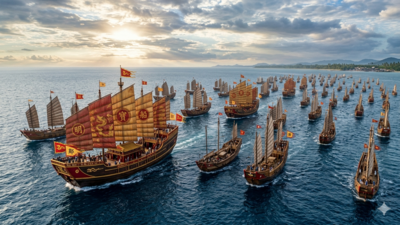
By the beginning of the 15th century, China possessed the most formidable navy that had ever existed. This fleet, known as the Treasure Fleet, was under the command of Admiral Zheng He and made journeys into the Indian Ocean, travelling to East Africa and even the Middle East. It was a clear indication of the dominance of the Chinese in technology, economy, and international relations before the emergence of the European empires. However, by the beginning of the 16th century, specifically around 1525, the treasure fleet was disbanded, and the Chinese started to look inwards.
The rise of the Chinese treasure fleet
The Ming Dynasty’s Treasure Fleet was impressive both technologically and in terms of organisation. Between 1405 and 1433, Admiral Zheng He led seven expeditions that comprised hundreds of vessels and tens of thousands of sailors. The Chinese fleet featured the largest wooden ships ever constructed.These expeditions were intended not for conquest but rather for diplomacy, commerce, and expansion of influence. Dr Sam Willis, in a podcast ‘The Society for Nautical Research’ with Professor Tim Brook, a historian of China at the University of British Columbia:“Zheng He’s maritime expeditions underscored China’s supremacy at sea.”By that time, China was possibly the most powerful country in terms of naval strength and economy, surpassing the contemporaneous European nations.
Why the treasure fleet was abandoned
Even though the fleet was successful, it ended abruptly. The politics in the Ming court became an influential factor. Confucian bureaucrats felt that such explorations were frivolous and unethical and preferred to concentrate on agricultural stability rather than trade.Following Zheng He’s death, the expeditions were considered extravagant and unnecessary and support for them faded quickly.By the 1520s, China had severely restricted maritime trade, reduced shipbuilding, and even destroyed documents about the voyages. In this way, China distanced itself from global affairs. Meanwhile, Europe expanded actively into the seas.
A historic mistake that changed global power
According to many historians, China’s abandonment of the Treasure Fleets opened the way for European dominance in exploration and trade. According to Kenneth Pomeranz in his work “The Great Divergence”:“The cessation of Chinese maritime expansion made possible advantages which European powers would shortly take advantage of.”While China was retreating from the sea, other nations like Portugal and Spain were expanding, and they finally transformed world trade relations. It is quite significant since only a few decades passed before European explorers formed their overseas empire.The Ming decision not to undertake further extensive maritime expeditions reduced a prominent navy from the Indian Ocean. By continuing the Treasure Fleet, China would be able to control global exploration and change trade, colonisation, and cultural exchange around the world.
Lessons from the Chinese treasure fleet
The tale of the Chinese Treasure Fleet is much more than the journey itself; it is a tale of opportunities lost. In an era when China was leading the way as a superpower in the world, it decided on seclusion rather than growth. This shift changed the course of history by giving others the chance to take the lead where China fell short.Modern scholars now recognise this event as a valuable case study for future decision-making processes. Shunning innovation and the rest of the world can result in long-term repercussions.