


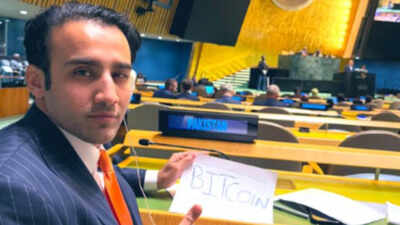
Bilal Bin Saqib (Photo credit: X/@Bilalbinsaqib)
In January 2026, Pakistan’s top civilian and military leadership hosted Zachary Witkoff, CEO of the crypto platform World Liberty Financial, for an engagement that closely resembled a state-level visit. While the formal centerpiece was a non-binding letter of intent to explore stablecoin integration for cross-border payments, the high-profile attendance of Pakistan’s prime minister Shehbaz Sharif and army chief Asim Munir underscored the event’s deeper geopolitical significance.According to Bloomberg, a group photograph from the event, showing Witkoff flanked by Pakistan’s top leadership, reinforced the quasi-official nature of the engagement. Also present was Bilal Bin Saqib, a central figure in the country’s crypto push, self-described as ‘crypto-bro’, who described the visit as helping to “put Pakistan on the map.”The episode highlights Pakistan’s growing use of digital assets as a diplomatic lever—what Saqib has termed “biplomacy.” By engaging with World Liberty Financial, a platform co-founded by the family of US President Donald Trump, Islamabad appears to be aligning itself with influential figures in Washington’s emerging crypto ecosystem while seeking to deepen ties within Trump’s orbit.At the same time, Pakistan has been viewed as a potential intermediary between the United States and Iran amid rising regional tensions. According to Steve Witkoff, Islamabad has presented a 15-point framework and has been discussed as a possible venue for talks ahead of a US deadline for Iran to reach an agreement or face escalation. Analysts caution that such a role remains contingent on shifting geopolitical dynamics, but note that personal connections within the Trump administration may be shaping the pace of engagement. Trump has also publicly praised Munir in recent months, underscoring the growing personal dimension of the relationship.Observers, including Michael Kugelman, have noted that Pakistan’s outreach—particularly its ties with Zachary Witkoff—may have helped it gain influence in Washington at a time when personal relationships play an outsized role in policymaking.Much of this outreach has been driven by Saqib, who rose rapidly within Pakistan’s policy ecosystem in 2025. He has played a key role in connecting the country with prominent figures in the global crypto industry, including Changpeng Zhao, who has faced regulatory scrutiny in the US, as well as Cathie Wood and Michael Saylor.The diplomatic push coincides with a broader domestic shift. After years of regulatory caution driven by concerns over fraud, money laundering, and financial instability, Pakistan has moved to formalize its approach to digital assets. Authorities have introduced legislation governing virtual assets, established a dedicated regulator, proposed a national crypto reserve, and allocated approximately 2,000 megawatts of power—about 5% of the grid—for crypto mining.The timing also aligns with a tentative improvement in US–Pakistan relations. The two countries are engaging on areas such as energy, critical minerals, and counterterrorism, while trade ties have also progressed, including reduced tariffs on Pakistani exports.Even so, risks remain. Pakistan continues to face obligations to the International Monetary Fund, which has historically taken a cautious view of sovereign crypto initiatives. Regional instability—including potential energy disruptions linked to tensions in the Strait of Hormuz—and the unpredictability of US foreign policy could also affect the trajectory of these efforts.For Saqib, however, the strategy is ultimately economic. He has emphasized the potential of digital assets to build domestic capacity, expand financial inclusion, and reduce Pakistan’s long-term reliance on external financial support.