


NEW DELHI: After months of haggling, the auto industry seems to have been comforted by the latest draft of the Corporate Average Fuel Efficiency (CAFE 3) norms, which encourage the use of new technologies and target major improvements, starting April 2027. CAFE are govt-mandated norms to reduce fuel consumption and carbon dioxide across a carmaker’s portfolio of vehicles.
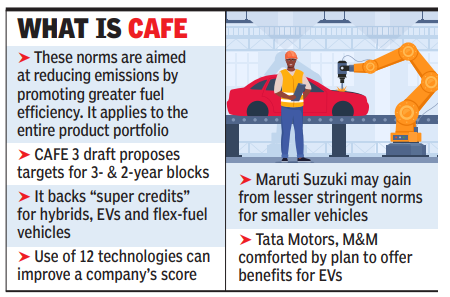
Under CAFE 3, to achieve the targets, carmakers will be given higher credits for vehicles with greater fuel efficiency, apart from “super credits” for producing EVs, hybrids or flex fuels (petrol or ethanol) vehicles. Further, use of 12-specified energy efficient technologies – such as start-stop system, six-speed or higher transmission, tyre pressure monitoring system or high-efficiency AC systems – can earn discounts for the car manufacturer, the draft circulated on Wednesday said. Carmakers can purchase credits from other carmakers “for compliance on their mutually agreed terms and conditions”. Unlike the earlier two versions of CAFE, which allowed companies to target efficiency over a five-year period, the third edition has proposed a block period of three years, followed by a two-year phase. Auto companies can miss annual targets but must meet it at the aggregate level, with records to be maintained in a passbook. Based on the draft, the efficiency score is targeted to be reduced from 113.5 at the end of 2026-27, the terminal year of CAFE 2, to 94.8 in 2027-28, when CAFE 3 kicks in and to 78.9 in the terminal year (2031-32). The Bureau of Energy Efficiency (BEE), which circulated the latest draft, has assumed that by 2031-32, CNG vehicles will be the biggest chunk of the vehicle mix, with a share of 35% by 2031-32, compared with 24% estimated in the current financial year. The share of petrol is projected to fall from 50% to 30.7% during this period. Similarly, share of electric vehicles is expected to rise from 4.5% to 11%, with strong hybrids accounting for 12% of the vehicles by 2031-32, according to a presentation made to the cabinet secretary on Wednesday. The revised draft has proposed relaxations for small cars compared to the earlier plan, but tightened the credits offered for hybrids and flex fuel vehicles. This is widely seen as a balancing act by govt. Besides, it seeks to lower penalties for violations. Automakers said the revised framework strikes a balance between India’s decarbonisation goals and industry’s transition challenges, while offering greater flexibility through credit trading, carry-forward provisions and a softer penalty mechanism. “The framework supports govt’s green goals, while ensuring a practical transition path for manufacturers,” an industry executive said.