


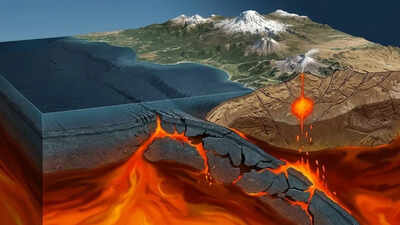
A groundbreaking study in Science Advances reveals that Earth’s tectonic plates are breaking apart under the Cascadia subduction zone. Geologists from Louisiana State University and the Lamont-Doherty Earth Observatory used high-resolution seismic imaging, similar to an ‘ultrasound’ of the Earth. They noticed the Juan de Fuca plate is fracturing into smaller pieces as it sinks beneath North America. This shows a ‘slow-motion train wreck,’ with the oceanic crust tearing instead of sliding smoothly. The findings give crucial insights into how subduction zones eventually fail and shut down. This process significantly reshapes continents and, over the long term, affects volcanic and seismic activity in the Pacific Northwest.
Juan de Fuca tectonic plate is breaking into pieces beneath Cascadia, study finds
Brandon Shuck’s research team found that the Juan de Fuca plate isn’t just one large piece; continuous slab but is instead fragmenting within the seismogenic zone. This happens because the young plate, which tends to float more easily, is pushed down under the uneven North American plate. According to a study published by Lamont-Doherty Earth Observatory, their imaging showed a tear about 75 kilometres long, along with other faults dividing the plate into separate structural areas. These tears clarify why some parts of the Cascadia margin are less active in terms of earthquakes compared to other subduction zones that experience more seismic activity.
Cascadia Subduction Zone explained: The tectonic boundary behind giant earthquakes and tsunamis
According to the Pacific Northwest Seismic Network (PNSN), Cascadia is the name given to the Cascadia Subduction Zone (CSZ), a fault line that spans 1,000 kilometres (621 miles) from Vancouver Island in Canada down to Northern California. It serves as the boundary where the dense oceanic Juan de Fuca plate is pushed beneath the larger and lighter North American continental plate. Unlike most geological boundaries, this zone is a ‘megathrust’ fault, which means it can unleash some of the world’s largest earthquakes and massive tsunamis. The area showcases dramatic landscapes like the Cascade Volcanic Arc. This arc came into existence when the subducting plate melted as it descended into Earth’s hot mantle.
Why the Cascadia crust is sinking unevenly
Researchers talk about how stopping a subduction zone is a big deal. Brandon Shuck, the main author, mentioned that while creating one of these zones is tough, shutting it down takes a huge structural breakdown. The study shows that the Explorer plate and parts of the Juan de Fuca plate are going through this ‘derailment.’ In this situation, the crust breaks apart and sinks unevenly. This process is called slab tearing, which allows hot mantle material to rise into the newly created spaces, which might lead to new or changed volcanic activity in the Cascade Range.
High-resolution imaging uncovers 3D tectonic fractures
To examine these fractures, scientists carried out seismic reflection imaging in the CASIE21 project. They sent sound waves into the Earth and captured how these waves reflected off various rock layers. From this information, a 3D model was created. This model revealed that the subducted plate is quite thin, often less than 6 kilometres thick, as noted in a study on the Lyell Collection. Because of this thinness, it can buckle and tear under the heavy weight of the continental crust above it.
