


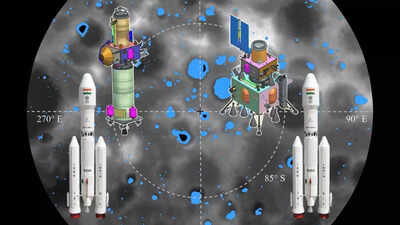
Indian research into the Moon is shifting toward deeper geological exploration rather than surface-level research alone. Research conducted by the Indian Institute of Technology Kharagpur, in association with the Physical Research Laboratory, explores the formation of ancient rocks on the Moon and the implications for its internal structure. The research is based on the processes that took place billions of years ago, with extreme pressure and temperature. The research will help prepare for the upcoming Chandrayaan-4 mission by specifying the landing regions and the sample composition that can be returned to Earth.
Chandrayaan-4 research by IIT Kharagpur explains how Moon rocks first formed
According to CSR Journal, the research looks at ilmenite-bearing cumulates, commonly referred to as IBC. These rocks formed around 4.3 to 4.4 billion years ago, during a stage when the Moon had a global magma ocean covering its surface. As the molten material cooled, heavier minerals gradually moved downward into the interior, creating layers over time. These layers remain beneath the surface and represent early stages of lunar development.To examine this process, the researchers recreated similar conditions in a laboratory. Rock samples were exposed to pressures close to 3 gigapascals and temperatures above 1,500 degrees Celsius, as reported. Under these conditions, partial melting occurred, producing material similar to titanium-rich basalts that have already been observed on the Moon.
What are the key findings from the research
The results show that the formation of magma depends on temperature. When the temperature increases, moderately titanium-rich melts are formed and then change to intermediate-Ti basalts through a more direct process.When the temperature decreases, the process takes a different path. The formation of high-titanium melts continues to evolve, increasing in titanium and becoming lower in magnesium. These melts then unite with other rising magmas before reaching the surface. This explains the differences in the formation of titanium-rich basalt samples obtained in previous lunar missions.
Magma movement shows a more dynamic Moon interior
The research shows there is movement in the Moon’s interior, but there is no fixed structure. There is molten material that moves towards the surface, which is attributed to lower pressure conditions, leading to volcanic activities. At higher pressures, this molten material moves downwards to the deeper parts of the mantle.The constant movement of this molten material is known as mantle overturn, where there is both upward and downward movement of this material, indicating a system in which redistribution occurs.
What this means for Chandrayaan-4
The results are also important for the planning of the mission by the Indian Space Research Organisation. The Chandrayaan-4 mission will retrieve samples from the Moon and return them to Earth. This requires the selection of landing sites.Understanding the formation and potential distribution of titanium-rich materials can help in identifying areas that are more scientifically valuable. The regions near the Moon’s south pole are considered for their surface characteristics and the presence of target materials.