


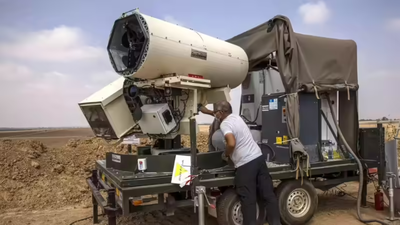
As conflict intensifies in the Middle East following US and Israel strikes on Iran and retaliatory attacks, reports have surfaced suggesting Israel may be using a laser-based air defence system to intercept incoming rockets from Hezbollah.Videos circulating online appear to show rockets being destroyed shortly after launch without visible interception, consistent with the effects of directed energy weapons. The system in focus is Israel’s Iron Beam, a high-energy laser designed to complement existing missile defence networks.
What is Iron Beam?
Iron Beam is a directed energy weapon developed by Rafael Advanced Defense Systems in collaboration with the Israeli defence ministry. Unlike traditional systems that rely on interceptor missiles, it uses a powerful laser to destroy targets by heating and burning them mid-air.A smaller version of the system was successfully tested in 2022 and later used operationally to counter drones. Mounted on a mobile platform, Iron Beam uses a roughly 100-kilowatt laser and can be deployed based on evolving threats.
How is it different from Iron Dome and other systems?
Israel’s existing air defence architecture includes systems like Iron Dome, David’s Sling and Arrow, which rely on missiles to intercept threats. These systems are effective but expensive, each Iron Dome interceptor costs tens of thousands of dollars.By contrast, Iron Beam is significantly cheaper to operate. Estimates cited by Israeli officials put the cost per shot at a few dollars ranging from $3 to $10, with more recent estimates suggesting it could be even lower. Another advantage is sustainability. Missile systems require reloading, while laser systems can continue firing as long as they have sufficient power, though they may need to pause to cool down.However, Iron Beam has limitations. Its range is shorter than missile-based systems, making it suitable mainly for drones, artillery and short-range rockets. It is also less effective in adverse weather conditions such as clouds or rain.
Role in current and recent conflicts
According to The Conversation and AFP, Israel has previously used a lower-powered version of the system during its 2024 conflict with Hezbollah, intercepting dozens of drones.The system is not intended to replace missile defences but to supplement them, particularly against low-cost threats like drones. In current conflicts with Iran, countries including the United States and Israel have expended large numbers of expensive interceptors against relatively cheap aerial threats.Directed energy weapons help address this imbalance by offering a low-cost alternative while preserving missile stockpiles for more complex threats.
Global race for laser weapons
Israel is not alone in developing such technology. The United States, China, Russia, Japan, Britain and France are all working on similar systems for land and naval use.“These systems have made a lot of progress in the last 10 to 15 years,” said Iain Boyd, director of a US-based security research centre, as quoted by AFP.Experts note that once deployed, the cost of firing such systems is minimal. “The cost of firing one laser or microwave is really the cost of electricity,” a defence expert told AFP, adding that it could be “pennies per shot.”
Challenges and future outlook
Despite the promise, technical challenges remain. Maintaining a steady beam on fast-moving targets is difficult, and environmental factors can reduce effectiveness.Still, as drone warfare expands, from Ukraine to the Middle East, laser systems like Iron Beam are expected to play a growing role in air defence.With rising demand for cost-effective countermeasures, directed energy weapons are increasingly seen as a key component of future military strategy.