


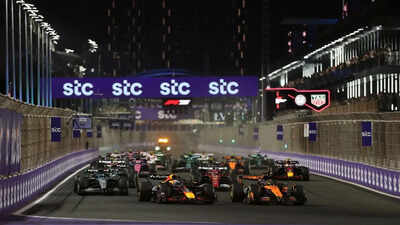
Every year, cities like Bahrain and Jeddah turn into high-speed marketplaces of wealth, hosting Formula 1 races that bring in celebrities, billionaires, and millions of fans. Hotels sell out, private jets line the tarmac, and millions of dollars move through the local economy in just a few days.This time, none of it will happen.As the ongoing war in West Asia disrupts airspace and unsettles travel, Formula 1 has cancelled two lucrative stops: the Bahrain Grand Prix and the Saudi Arabian Grand Prix. “While alternatives were considered, no substitutions will be made in April,” announced Formula 1.The official stance from Formula One Group has been consistent: safety comes first. But behind that lies a more complex reality. Formula 1 today is not merely a sport; it is a travelling luxury economy, one that moves billions of dollars across continents in a matter of days. And when a race disappears, so does that money.The price of not racingThe first hit comes from hosting fees, a key pillar of Formula 1’s business. Bahrain and Saudi Arabia together pay about $115 million a year to stage their races, according to estimates from Guggenheim Partners and industry disclosures. When a race is cancelled, that revenue disappears.These fees flow into Formula One Group’s central pool, which distributes about $1.4 billion in prize money to teams each year. Any shortfall trims the payouts.
Hosting a Grand Prix also positions cities on the global stage. Each race is not a sporting event, but a showcase.
Mohammed Ben Sulayem, president of the FIA
Inside the paddock, the mood has been calm. Pointing to income from broadcast deals and sponsorships, Zak Brown, CEO of McLaren Racing, said during the Australian Grand Prix weekend, “We’re not bothered if it does have a little bit of a financial impact… so be it.”There is also a cushion. The entry of Cadillac as Formula 1’s 11th team from 2026 came with a dilution fee of more than $400 million (Rs 3,330 crore), as reported by Forbes. It compensates for prize money now being split among more teams and is shared among existing outfits, giving each a one-off boost of over $40 million this year.The cancellations are also unlikely to strain Formula 1’s ties in the region. The Bahrain Grand Prix is contracted until 2036, and the Saudi Arabian Grand Prix until 2030, underlining their long-term importance.FIA president Mohammed Ben Sulayem described both races as “incredibly important” to the season, signalling that this is a pause, not a pullback.
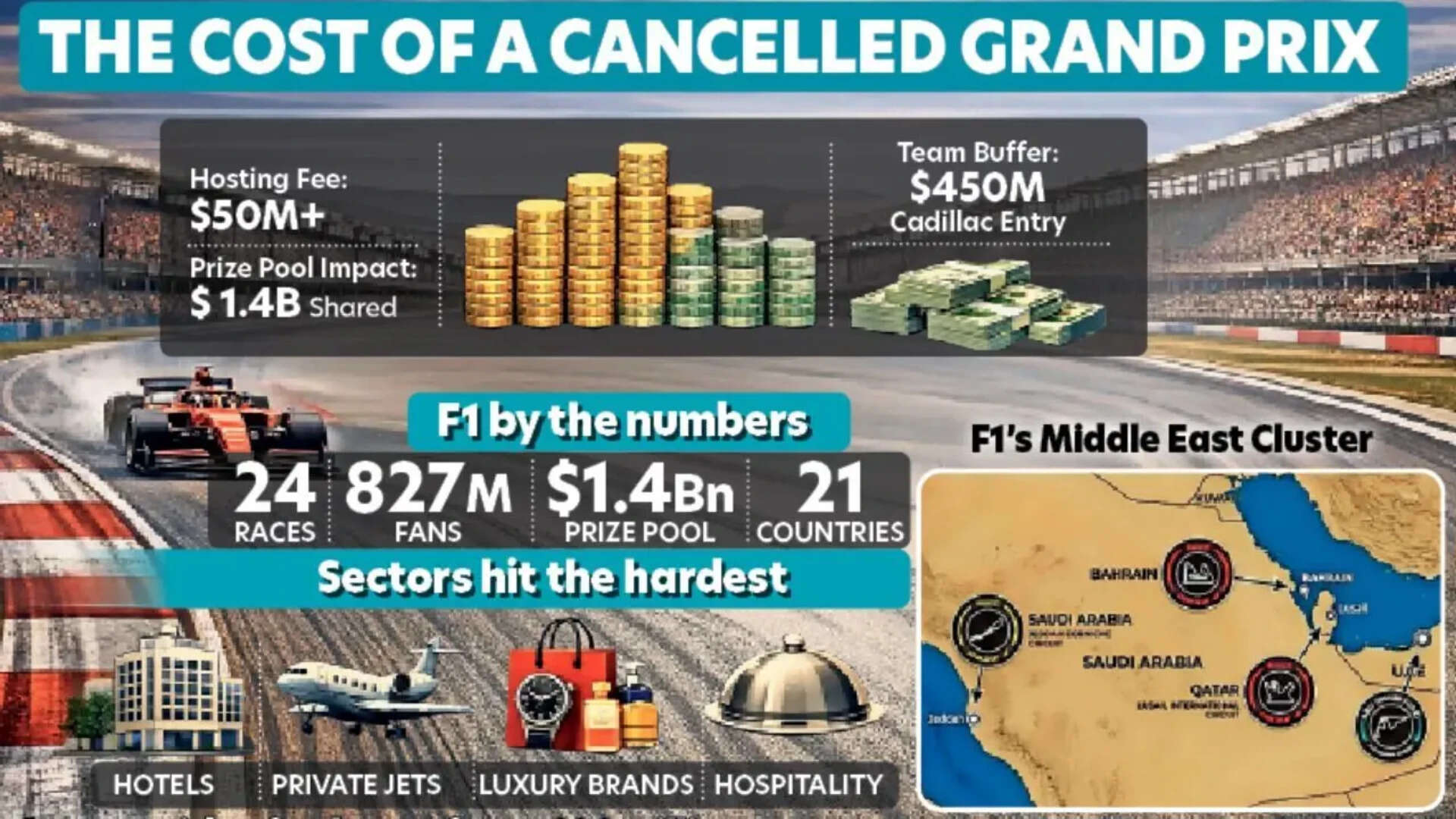
Where the real loss liesThe real cost of a cancelled Formula 1 race is not borne by teams. It is felt in the cities that host it.“A Formula 1 Grand Prix generates benefits across many sectors of the host country’s economy,” Mohammed Ben Sulayem, president of the FIA, told Finance Middle East in 2025. “While the immediate impact is strongest in hospitality and tourism, the wider economic value touches a much broader range of industries.”That impact is immediate and measurable. In 2025, the race weekend in Jeddah pushed hotel occupancy to 82.5 per cent, up more than 20 per cent year on year, according to CoStar. Average room rates rose to $222, while revenue per room jumped nearly 33 per cent. On peak nights, occupancy touched 96.5 per cent, with rates doubling in some properties.In Bahrain, the economic footprint is just as clear. The Bahrain International Circuit estimates that its Grand Prix weekend generates around $100 million each year.This is why Formula 1 has become more than a race. “Hosting a Grand Prix also positions cities on the global stage,” Ben Sulayem said. “Each race is not a sporting event, but a showcase.”A sport with a fan base of over 820 millionThe cancellations come at a time when Formula 1’s financial and cultural momentum remains strong.According to Formula 1 and industry estimates cited by Forbes, the sport’s global fan base now exceeds 820 million. The 2025 season featured a record 24 races across 21 countries, while attendance continues to surge, with Silverstone drawing more than 500,000 people over a race weekend.For host cities, that translates into a very specific kind of visitor.“These visitors typically have a higher propensity to spend,” said Glenn Harwood, CEO of data analytics firm AlgoDriven, to Arab News, pointing to the spending across hotels, fine dining and retail.When a race is cancelled, that flow stops. The global business of Formula 1 absorbs the shock. The local economy does not.F1’s 2025 Scorecard
Formula 1 has become more than a race.
$3.87 billion in revenueFormula 1 generated $3.87 billion in revenue in 2025, according to Forbes, underlining the scale of the sport’s global business model.827 Million fansFormula 1’s global fan base rose to 827 million, up 12% year-on-year and 63% since 2018. Silverstone alone drew 500,000 attendees across the race weekend. $630 million on screeThe F1 film added to Formula One Group’s revenue surge – helping push quarterly earnings to $1 billion and deepening the sport’s cultural and commercial reach, reported Forbes.