


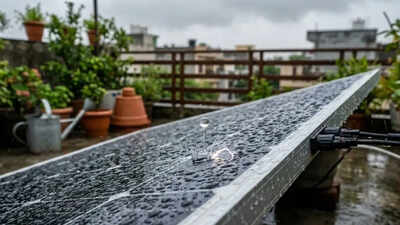
The shift to renewable energy sources generally faces a significant bottleneck: producing electric power in bad weather. A team of researchers has created a new type of energy harvesting system that maintains power generation when clouds and rain develop over the solar electric cells. The hybrid energy harvesting system uses high-efficiency perovskite solar cells and novel triboelectric nanogenerator technology, which captures energy from the sun and from the kinetic energy of falling rain hitting the specialised surface of the device. The device has a patented thin film surface with a thickness of 100 nanometers that generates more than 110 volts of energy from just one raindrop while keeping the photovoltaic surfaces dry and protected from water penetration. This technology represents a significant advance toward creating truly weather-independent autonomous power generation systems suitable for use in smart cities and in remote locations where real-time monitoring of the environment is required.
How raindrops can generate electricity: Science behind hybrid solar panels
Solar energy has historically been linked to sunny days and blue skies; however, this new combination of solar technologies has created a hybrid electric generation system by using the Triboelectric Effect to harness energy from friction caused by raindrops falling onto an electrically treated surface. Each time a raindrop touches and separates from the surface area of the treated panel, an electrical charge is generated as a result of this arrangement. The findings from the study published in Nano Energy illustrate that these types of devices can generate substantial amounts of high voltage (up to 110 volts) harvested from mechanical impact produced by falling rain, thereby turning an otherwise ‘bad’ (rainy) daytime into a productive source of electrical energy.
The secret behind Perovskite’s enhanced solar absorption
In terms of how these devices utilise solar energy, the ‘solar’ component of the hybrid system is composed of Halide Perovskites, which are synthetic materials that have outperformed traditional silicon in terms of efficiency recently. In addition to their level of efficiency, Halide perkovskites also tend to be very moisture-sensitive; however, according to Spanish National Research Council (CSIC) a team from the Institute of Materials Science of Seville (ICMS), a joint center of the Spanish National Research Council (CSIC) and the University of Seville developed a plasma-enhanced deposition technique a protective barrier on top of the halide perovskite material to prevent the degradation of the solar cells when immersed in water and also allow for additional light absorption by the solar cells to increase their efficiency at converting sunlight into electrical energy.
Why hybrid panels are the backbone of autonomous sensors
There are many potential uses for these hybrid panels, especially regarding the Internet of Things (IoT). As a result of how they’re manufactured using scalable plasma-enhanced chemical vapour deposition (PECVD), their method of mass-producing this technology is sustainable. These panels will be utilised in ‘Smart Cities’ to provide power to autonomous sensors, weather stations, and auxiliary lighting that need to operate continuously, regardless of whether the sun shines or not, meaning there are no interruptions due to whether it’s bright and sunny outside or storms occur outside.
Solving the longevity crisis in remote power systems
According to research by the European Research Council (ERC), this technology is intended to reduce our dependence on traditional batteries, which have a limited life span and are environmentally unfriendly. By being able to provide a continuous power source from the environment (via sun and rain), these panels represent a more reliable option for providing power in places that are remote or difficult to access, such as marine stations or structural inspections on the bridge.